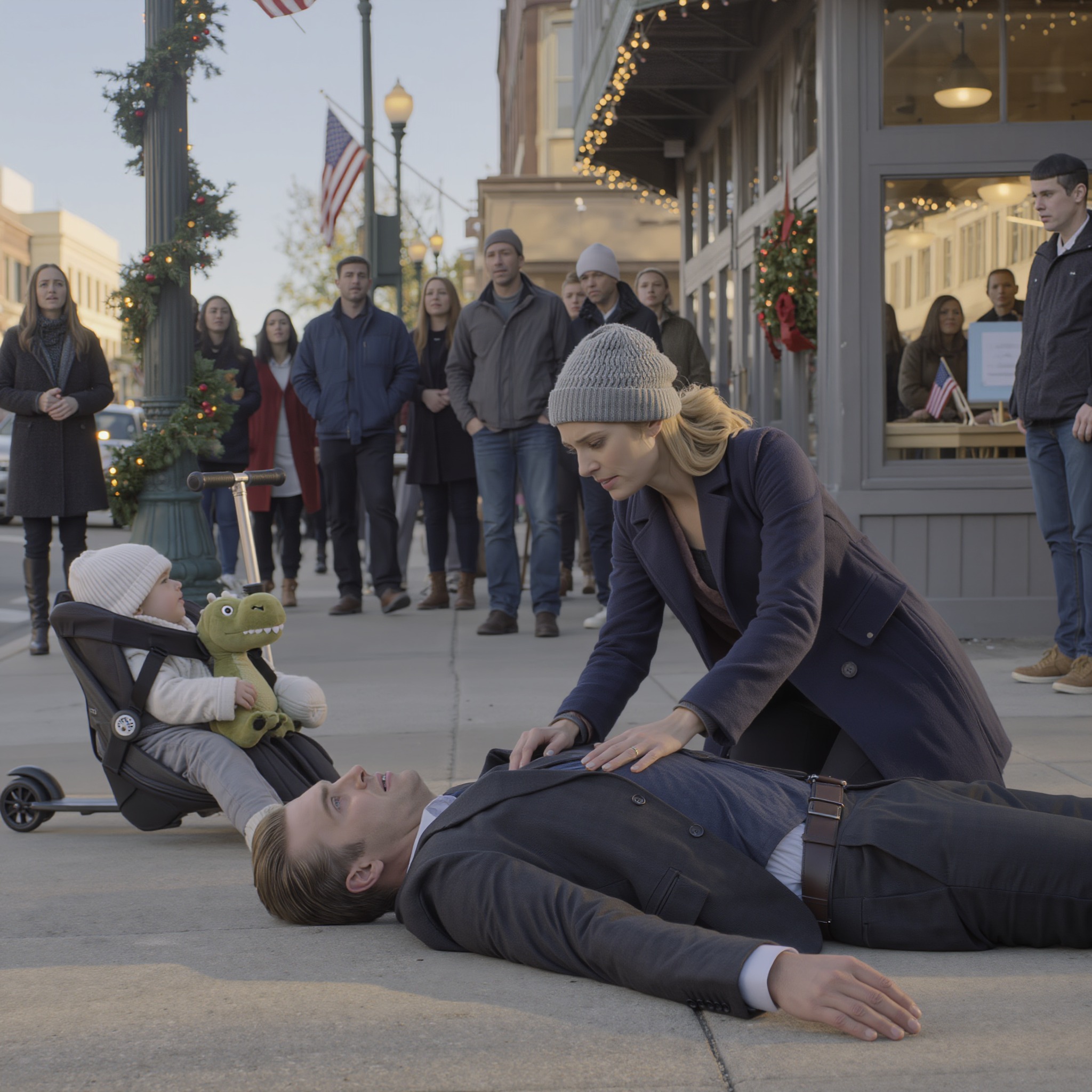
“Molly Hayes?”
She nodded. “Yes.”
“I hope I’m not interrupting.”
“You’re not.”
“I wanted to thank you in person.”
“I got the flowers,” she said flatly. “And the note.”
“And no reply.”
“I didn’t think you needed one.”
He chuckled softly. “Fair enough.”
He glanced toward a quiet table.
“Would you let me buy you lunch as a thank you?”
“With all due respect, Mr. Wittman,” she replied, “I don’t need a reward.”
“It’s not a reward. Then a gesture, maybe.”
Molly met his eyes.
“I’m glad you’re alive. That’s all I wanted. I didn’t save you for lunch. I saved you because no one else did.”
There was no resentment—only honesty.
Charles paused, then nodded.
“You’re right. I respect that.”
A quiet moment passed between them, still and sincere.
“I’ll let you get back to work,” he said.
Molly gave the faintest smile.
“Just try not to collapse again.”
He laughed, a real laugh that softened his whole face.
“For what it’s worth, Miss Hayes… being turned down has never felt more humbling.”
And just like that, he left.
No spectacle.
No pressure.
Molly stood there for a long second, watching him disappear into the stream of city life.
For the first time, she wondered if maybe true gratitude didn’t come in grand gestures.
Maybe sometimes it showed up quietly—with presence, with humility—even in the form of a man who nearly died in your arms.
Charles Wittman returned to the café the next morning and the morning after that. Not every day—just often enough that Molly noticed.
He always came alone, ordered black coffee, no sugar. Sometimes he sat by the window with a folded newspaper. Other times he stood quietly by the counter.
He never brought up the rescue. Never asked for attention.
He just showed up.
At first, Molly kept her distance. A billionaire did not hang around a local café for fun.
But over time, his presence became familiar—less strange.
One Tuesday morning, after a night of broken sleep, Molly leaned against the counter as Charles waited for his drink.
“I haven’t slept through the night since Eli was born,” she muttered, mostly to herself.
Charles raised an eyebrow.
“Eli’s your son?”
She nodded, brushing her hair back.
“A year and four months old. A full-time job, no paycheck.”
Charles smiled faintly.
“Sounds relentless.”
“It is. I work here, and I deliver orders in the evenings. Rent, diapers… it piles up.”
She paused, unsure why she was telling him.
“It gets lonely,” she added quietly. “When your whole world is a toddler who cries because his banana broke.”
Charles didn’t laugh.
He just nodded.
“I know that kind of loneliness.”
Molly blinked, surprised.
“I grew up in a house where success was mandatory,” he said. “Tutors, schools, rules. But affection? No one knew how.”
He paused.
“I was married once, briefly. No kids. I built companies and networks, but at the end of the day, I still go home to silence.”
That admission made Molly look at him differently.
Not as a CEO.
Just a man.
A few days later, Charles came during her afternoon shift, and for the first time, Eli was with her—curled in a stroller, chewing his sleeve, frowning at the lights.
Charles bent slightly.
“Hello there.”
Eli shrank back, burying his face in Molly’s leg.
“He’s shy,” she said, lifting him up. “Not used to strangers.”
Charles didn’t push.
He reached into his coat and pulled out a small stuffed bear—blue, with button eyes.
Molly frowned.
“Where did you—”
“I asked the girl at the shop across the street,” he said. “She said blue was a safe bet.”
Eli eyed the bear, then reached out.
The ice began to melt.
Two days later, Molly’s old medical bills vanished from her account.
An anonymous payment had cleared the balance.
She suspected Charles, but he said nothing.
The bear stayed too.
No note.
No explanation.
Late one night in November, Eli burned with fever.
Molly panicked.
No car.
No money for urgent care.
Buses no longer running, rideshares long lost.
She was about to call 911 when headlights lit up her small yard.
“Charles—”
“I spoke with your neighbor,” he explained. “The one you borrowed jumper cables from. He pointed me here.”
Molly said nothing.
She wrapped Eli in a blanket and climbed into his car.
At the hospital, Charles stayed.
He held the diaper bag. Brought water. Spoke with nurses. Rocked Eli when Molly’s arms gave out.
When the doctor finally said it was a virus, that the fever had broken, Charles sat beside the crib all night.
He didn’t check his phone.
He didn’t glance at his watch.
At 2:00 a.m., a nurse passed by and paused.
“Is that Charles Wittman?” she whispered. “The Charles Wittman in pediatrics? I think he’s with the young mother.”
They watched in silence—not out of awe for his wealth, but for his choice to be there, to stay with a child that wasn’t his, to be present for a mother with nothing to offer but truth and gratitude.
In that quiet hospital room, something unspoken formed.
Not love.
Not yet.
But something real and lasting.
Oh.
A week after the hospital night, Charles returned to the café with something in a manila envelope.
He waited until Molly’s shift slowed, then approached the counter.
“I have been thinking,” he said gently. “You once said you started nursing school before Eli.”
Molly glanced at the envelope.
“Yeah. I dropped out when I got pregnant.”
Charles slid it toward her.
“This is a full scholarship if you want it. For any program you choose. No strings.”
Molly stared.
Her hand hovered, then pulled back.
“I don’t know,” she said. “It is a lot.”
Charles did not press.
“Just think about it.”
She nodded.
“I will.”
But she did not open the envelope for two days.
When she finally did, it was real.
Program options.
Paid tuition.
Local college contacts.
He had done the legwork.
Made it easy.
Maybe too easy.
That scared her.
At work, her friend Harper noticed something was off.
“You’ve got that look,” Harper said. “What’s going on?”
Molly hesitated, then told her.
